

The Slocan Valley focal area was added in Year 5 of Kootenay Connect Priority Places. Highlights from Year 5 (2023-24) to Year 7 (2025-26) are listed below.
Year 7 Highlights (2025-26)
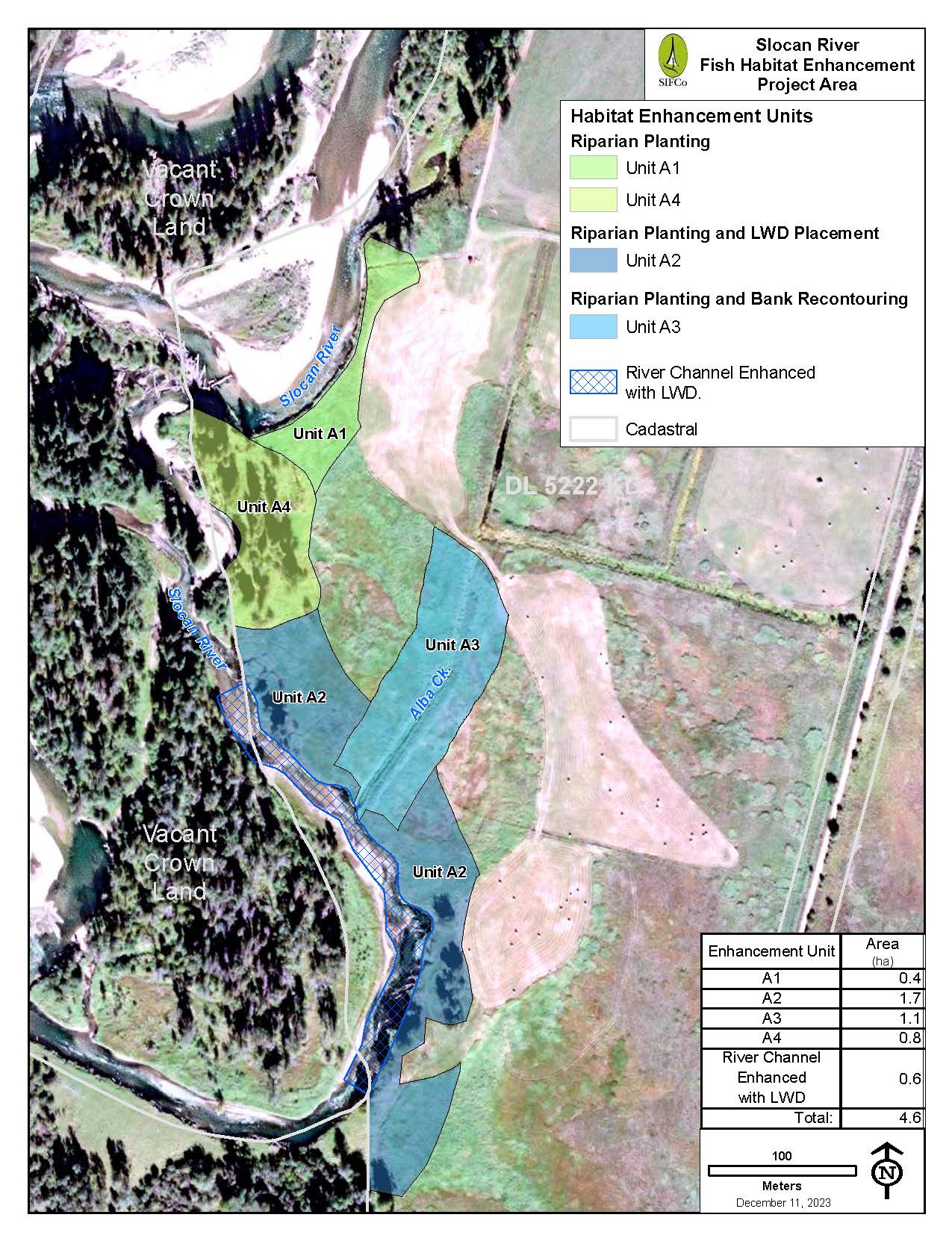
The Slocan Integral Forestry Cooperative (SIFCo) is completing a 3-year riparian and upstream restoration project at the Larsen Ranch site. The Kootenay Connect Priority Places portion of this larger restoration project was limited to riparian enhancements to improve fish habitat along this vital spawning section of the Slocan River. Resources and revegetation expertise were delivered for A1 and A2 restoration units.
Slocan Lake Stewardship Society (SLSS), in conjunction with Slocan River Streamkeepers (SRS), have completed the first phase of a riparian restoration and enhancement project on two crown land sites on the Slocan River: Perry Bridge (north and south) and Oxbow Island. The sites are situated on active low and mid-bench floodplains including roughly 2.5 km of shoreline and 13.8 ha of land. The enhancement of these sites will improve fish habitat in the river by ensuring that the cottonwood stands persist and large woody debris continues to enter the riverine system, and riparian vegetation provides shade and food. In addition, a healthy riparian community will help reduce riverbank erosion. As an integral component of the Perry-Oxbow restoration works, wildlife habitat enhancements were completed with the installation of bird nesting boxes and western painted turtle basking logs. There are several species-at-risk that have been observed in the restoration sites, including western painted turtle (Chrysemys picta), Lewis’s woodpecker (Melanerpes lewis), great blue heron (Ardea herodias herodias), tundra swan (Cygnus columbianus), bank swallow (Riparia riparia), and western screech owl (Megascops kennicottii).
Year 6 Highlights (2024-25)

Black cottonwood floodplains perform critical ecological functions in healthy watersheds, as they are the interface between aquatic and terrestrial ecosystems and integral to watershed hydrology. Mature cottonwood forests adjacent to rivers are biodiversity hotspots that provide the greatest diversity of habitat for the most species in the valley. Therefore, protecting and enhancing existing black cottonwood ecosystems and restoring degraded areas in the Slocan Valley is one of the most important conservation actions that can be undertaken to benefit the greatest number of species over time. We are proposing to restore and enhance two crown land sites on the Slocan River: Perry Bridge (north and south) and Oxbow Island. Both sites are situated on active low and mid-bench floodplains including roughly 2.5km of shoreline and 13.8 ha of land. We are also working with a landowner to restore several hectares of riparian area on private land along a Slocan River side channel just south of Lemon Creek, which will be done in conjunction with in-stream fish habitat restoration work.
Year 5 Highlights (2023-24)

Black cottonwood floodplains perform critical ecological functions in healthy watersheds, as they are the interface between aquatic and terrestrial ecosystems and integral to watershed hydrology. Mature cottonwood forests adjacent to rivers are biodiversity hotspots that provide the greatest diversity of habitat for the most species in the valley. Therefore, protecting and enhancing existing black cottonwood ecosystems and restoring degraded areas in the Slocan Valley is one of the most important conservation actions that can be undertaken to benefit the greatest number of species over time. We are proposing to restore and enhance two crown land sites on the Slocan River: Perry Bridge (north and south) and Oxbow Island. Both sites are situated on active low and mid-bench floodplains including roughly 2.5km of shoreline and 13.8 ha of land. We are also working with a landowner to restore several hectares of riparian area on private land along a Slocan River side channel just south of Lemon Creek, which will be done in conjunction with in-stream fish habitat restoration work.


