

The Duncan Lardeau focal area was added in Year 5 (2023-2024) of Kootenay Connect Priority Places. Highlights from Year 5 (2023-24) to Year 7 (2025-26) are listed below.
Year 7 (2025-26)
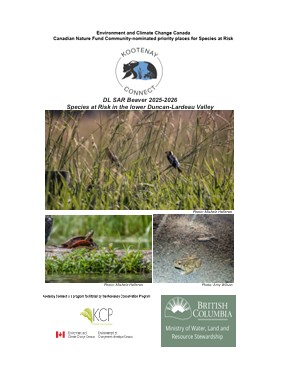
The 3-year species at risk (SAR) subproject has been part of a landscape-scale initiative with Kootenay Connect Priority Places at the north end of Kootenay Lake. Surveys and investigations for a small subset of ‘umbrella’ and ‘indicator’ species classed federally or provincially at risk and/or locally of concern have been undertaken, in an effort to assess threats and related needs for protection and stewardship. Surveys have confirmed breeding locations used by Pacific treefrog and western toads; confirmed the presence of sora and other marsh bird species in 13 out of 14 surveyed wetlands; confirmed nesting by 20 bank swallows at one riverbank nest site; confirmed nesting by 2+ pairs of common nighthawk and detailed winter roost tree use by great blue herons.
Year 6 (2024-25)
Please see Project Overview Year 6 Highlights for an update on Corridors & Connectivity.
Year 5 (2023-24)

As part of a long-term project to restore wetland and beavers on the Duncan-Lardeau floodplain, this project carried out live-staking of willow along a waterway locally known as the Argenta Slough. There were three primary objectives for this endeavour: (a) To increase structural (and species) diversity, in an otherwise grass-dominated habitat; this is expected to be of particular benefit to a variety of birds; (b) To eventually provide food for beavers (though may need to be protected in the short term), and; (c) To eventually out-compete Reed canary-grass (RCG). Experience in other areas has shown densely planted willow can dominate over RCG once established.


