

The Columbia Lake focal area was added in Year 5 (2023-2024) of Kootenay Connect Priority Places. Highlights from Year 5 (2023-24) to Year 7 (2025-26) are listed below.
Year 7 Highlights (2025-26)
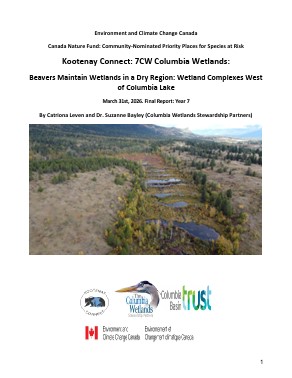
In previous work, the Columbia Wetlands Stewardship Partners (CWSP) found that the upland bench west of Lake Windermere and Columbia Lake has a greater moisture deficit than the upland benchlands further north, resulting in a higher potential for wetlands that are vulnerable to climate change. In 2025, CWSP returned to finish surveys of beaver dams/lodges in the Upper Marion Creek West Wetlands. Given the lack of permanently inundated wetlands in this area, these wetlands and the beaver dams that maintain them are particularly important in providing wetland habitat and water on the landscape. In 2025 CWSP also surveyed the beaver dams and lodges in the wetland complex approximately 1.5 km north-east of the Upper Marion Creek West Wetlands complex, and confirmed local knowledge that these wetlands are drying.
Year 6 Highlights (2024-25)
In 2024, CWSP conducted two areas of research in wetlands on the upland bench west of Columbia Lake. This area was identified in previous work as particularly vulnerable to climate change. We first visited 17 wetlands and conducted vegetation and soil surveys in collaboration with The Nature Trust of BC, then focused on the upper reaches of Marion Creek and assessed the impact of beaver dams. We found that of the 17 wetlands we visited, only five had surface water present, and only two were considered to have water with a permanent hydroperiod, meaning they will be wet all year round. We also conducted more detailed surveys of beaver dams and lodged in the Upper Marion Creek West Wetlands and found 46 beaver dams, 24 of which were active, and nine beaver lodges, five of which were active. These active dams hold approximately 33,447 m3 of water on the landscape, create marsh, swamp, and fen wetland habitat, and help regulate the flow and temperature of Marion Creek, all of which increases biodiversity and is important for species such as Westslope Cutthroat Trout (Oncorhynchus clarkii lewisi) found in Marion Creek.
Year 5 Highlights (2023-24)

Within the Upper Columbia Wetland, an area known for its undammed and relatively natural floodplain wetlands, there is a series of wetlands colloquially known as the Bench Wetlands that exist along a benched hillside in the upland area on the west side of the Columbia Valley along the base of the Purcell Mountains. These wetlands have faced numerous stressors, such as forestry, ranching, development, and many appear to have dried up, particularly in the more southern extent. While these wetlands may be smaller than the floodplain wetlands in the valley bottom, these small wetlands are still extremely important, as smaller wetland ecosystems can provide an ecological network known as a wetlandscape, which can include both connected (either to a stream or a lake) and disconnected wetlands (i.e. those that do not appear to have any surface water connections). In the current study, we examine the Bench Wetlands in the Columbia Valley to assess their vulnerability to climate change and determine what drivers might be important in affecting their vulnerability. This study will be used to guide future monitoring, modelling, and restoration efforts.


