

The Columbia Lake focal area was added in Year 5 (2023-24) of Kootenay Connect Priority Places. Highlights from Year 6 (2024-25) & Year 7 (2025-26) are listed below.
Year 7 Highlights (2025-26)
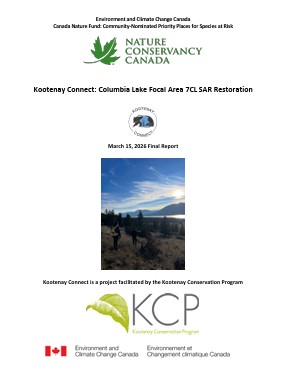
The focal Species at Risk (SAR) relying on the IDF ecosystem in this area include American badger, bighorn sheep, grizzly bear, Lewis’s woodpecker, and common nighthawk. The key measurable outcomes of Year 7 by the Nature Conservancy of Canada in the Marion Creek Benchlands, Thunder Hill Ranch, Dutch Creek Hoodoos and Columbia Lake Lot 48 Conservation Areas are as follows. The development of a forest thinning and prescribed fire preparatory prescription for Columbia Lake Lot 48, open forest thinning treatments of 58.12 hectares at Thunder Hill Ranch 3, open forest thinning and pile burning treatments of 15.97 hectares at Columbia Lake Lot 48, and removal of 2700 metres of derelict fencing at Columbia Lake Lot 48.
The Kootenay Connect Fairmont Keystone Corridor Project focuses on preserving ecological connectivity between the Purcell and Rocky Mountains by targeting a critical wildlife corridor near Columbia Lake. This stewardship initiative targeted one key parcel, which tied into complementary efforts on adjacent properties. The project has achieved its objective to enhance grassland and riparian habitats for native species and has co-benefits to the people in the area. Collaboration with local landowners and the Farmland Advantage program ensures ongoing habitat improvement, connectivity and reduced flood and fire risk throughout the region.
This video summarizes projects undertaken in Year 7 of Kootenay Connect Priority Places, in the Columbia Lake region, by the Nature Conservancy of Canada.
Year 6 Highlights (2024-25)

Marion Creek Benchlands, Thunder Hill Ranch, Dutch Creek Hoodoos and Columbia Lake Lot 48 Conservation Areas are part of an important complex of conservation and protected lands adjacent to Columbia Lake. These lands have been conserved by the Nature Conservancy of Canda (NCC) and are stewarded for the benefit of the imperiled Interior Douglas-fir (IDF) ecosystem, focal species at risk (SAR), and the maintenance of wildlife movement corridors. The goal of this project is to build from previous restoration work, to enhance dry open forest habitats in the Columbia Lake Focal Area for the benefit of species at risk. In the Columbia Lake Focal Area, it has become clear that one of the most effective ways to improve habitat for these species is to reduce young forest densities and promote the transition to mature open forest stands. Treatment prescriptions for restoring mature open IDF stands include reducing conifer stem density through forest thinning. In addition to forest thinning, this can be achieved through prescribed burning. Work is underway led by Ktunaxa Nation Council and ʔakisq̓nuk to carry out prescribed burning on the east side of Columbia Lake in the coming years. This final report provides an update for work that NCC has been carrying out in the Columbia Lake Focal Area in Year 6, as part of the Kootenay Connect initiative.
The project by the Windermere District Farmers’ Institute targets the Fairmont Keystone Corridor, which has been identified as a critical corridor for ecological connectivity between the Purcell and Rocky Mountains. The goal of this project for Kootenay Connect is to retain the critical connectivity in this wildlife corridor at the north end of Columbia Lake and to improve the health of the grassland and riparian habitats for the benefit of the many species that depend on them. This goal will be accomplished by contracting the farmers who manage the land to improve habitat quality and thereby its connectivity through relevant stewardship projects.


