

The highlights from Year 3 (2021-22) to Year 7 (2025-26) are listed below.
Year 7 Highlights (2025-26)
This subproject by Columbia Wetlands Stewardship Partners (CWSP) focuses on monitoring and mitigating the impact of beavers on cottonwood/aspen stands throughout the Columbia Wetlands and includes the installation of wire guards on important cottonwood trees as well as assessment/repair of past wire guards on trees. Previously completed wetland mapping and canoe surveys have identified critical stands of cottonwoods for targeted wrapping. Building on the work done in Year 6, the work in Year 7 included identifying high quality wildlife trees or cottonwood stands for wrapping using the CWSP wetland mapping. Mature cottonwoods with existing nest structures or evidence of wildlife use were prioritized, as well as stands with multiple mature trees and younger recruitment trees. All identified stands showed evidence of beaver activity.
Year 6 Highlights (2024-25)
This subproject by Columbia Wetlands Stewardship Partners (CWSP) focuses on monitoring and mitigating the impact of beavers on cottonwood/aspen stands throughout the Columbia Wetlands and includes the installation of wire guards on important cottonwood trees as well as assessment/repair of past wire guards on trees. Previously completed wetland mapping has identified critical stands of cottonwoods for targeted surveying. Building on the work done in Year 5, the work in Year 6 included assessing beaver activity along the Columbia Wetlands via canoe and identifying high quality wildlife trees or cottonwood stands for future wrapping. Mature cottonwoods with existing nest structures or evidence of wildlife use were prioritized, as well as stands with multiple mature trees and younger recruitment trees. All identified stands showed significant evidence of beaver activity. Previously installed wire guards were assessed on trees near Radium, Brisco, Parson, and Golden.
Year 5 Highlights (2023-24)
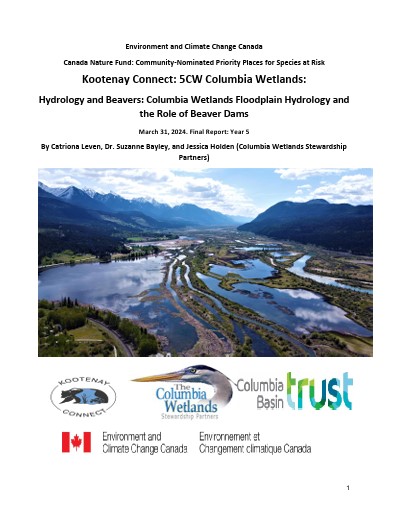
Better understanding the Columbia Wetlands will allow us to make more informed decisions about conservation and restoration strategies for the area. Thus, the Columbia Wetland Stewardship Partners aim to do both research and conservation actions to best protect this magnificent ecosystem. Our research has found three groups of wetlands within the Columbia Wetlands complex, which can be characterized by their connectivity to the Columbia River as Most Connected, Partially Connected, and Least Connected. In some years, the Partially Connected group can be further separated into Partially Connected – Bigger Gaps and Partially Connected – Smaller Gaps. These wetlands differ hydrologically, particularly in their response to the Columbia River flood pulse, which is a major driving force of the Columbia Wetlands complex due to the undammed nature of this part of the river.
The western upland bench of the Columbia Valley provides a suitable landscape for many small wetland features where minimal investigative work has been completed. The Freshwater Atlas of BC (FWA), an open-source database that maps provincial freshwater attributes, identifies 349 lake and 479 wetland polygons on the bench between Canal Flats and Spillimacheen. In 2023, the Columbia Wetlands Stewardship Partners (CWSP) visited 371 of the 828 (45%) mapped polygons either via drone or in-person to generate a summary of wetland status and identify potential restoration sites. To assess wetland status, they recorded the presence/absence of vegetation communities (e.g., open water, wetland vegetation, shrub, conifer) and noted the dominant and subdominant community for 94% (350 out of 371) of the visited wetland and lake polygons. CWSP’s project goal is to restore 5 – 10 hectares of wetlands on the upland bench of the Columbia Valley using Beaver Dam Analogues – in 2023, they identified 22 potential sites that are suitable for restoration with this method.
Year 4 Highlights (2022-23)
This short video documents efforts made by the Columbia Wetlands Stewardship Partners (CWSP) to conserve high-value cottonwood stands and wildlife trees in the Columbia Wetlands. Cottonwoods provide habitat for large raptors, great blue herons, woodpeckers, as well as important forage and building materials for beavers. These important wildlife trees are limited and valuable in the Columbia Wetlands.

The cottonwood conservation project promotes retention of mature wildlife trees in the Columbia Wetland by protecting trees from beaver herbivory. Wetland mapping and surveys in Year 1 identified critical stands of cottonwoods within the project areas.
Building on the work completed in Year 3, the work in Year 4 was aimed at targeting high value cottonwood trees. Mature cottonwoods that had existing nest structures were prioritized, as well as stands with multiple mature trees and younger recruitment trees. Almost all of these stands were near significant evidence of beaver activity.
Year 3 Highlights (2021-22)

As part of the 4-year study into the Columbia Wetlands, we are conducting research into the impacts of beaver dams on individual wetlands within the Columbia Wetlands complex. As this is a 2-year project, in this report we present preliminary results and describe the completed and ongoing work. 38 study wetlands are being studied for this research, covering 2395.61 ha or approximately 9% of the total area of the Columbia Wetlands.

The purpose of the cottonwood/beaver project is to assess the status of important cottonwood stands and install wire protectors if they are required to protect critical stands from beaver harvesting. If feasible, start to assess the regeneration of cottonwood on the levees. This subproject used the wetland mapping from Yr1 to identify the stands of cottonwoods, used a survey of important wildlife cottonwood trees to identify critical trees and small stands, and then after seeking permission of selected landowners, installed wire around selected cottonwood trees. In total 45 large trees, often near active beaver colonies were protected. The project brought in a Youth Climate Corp to assist with the installation of the wire.


