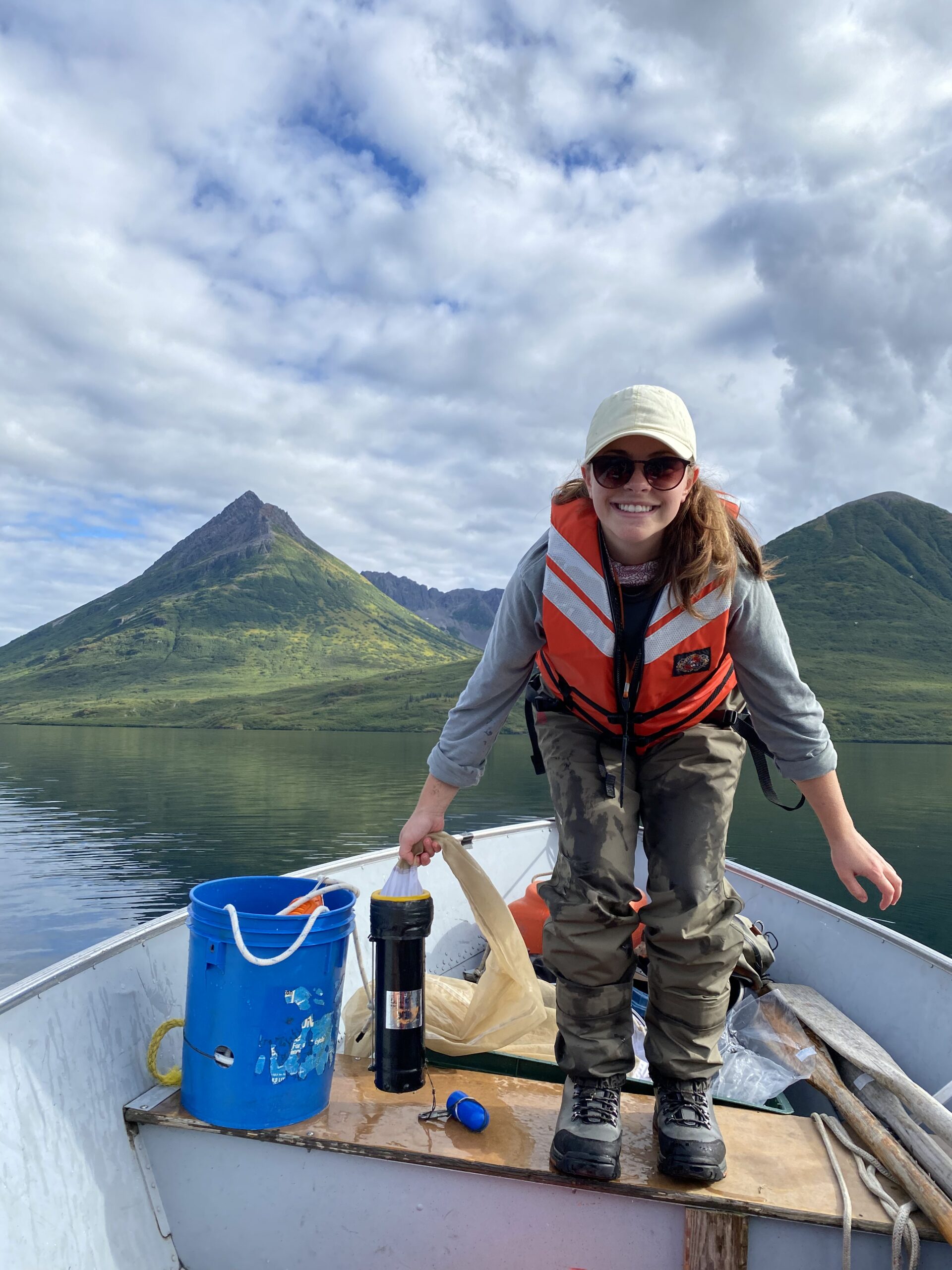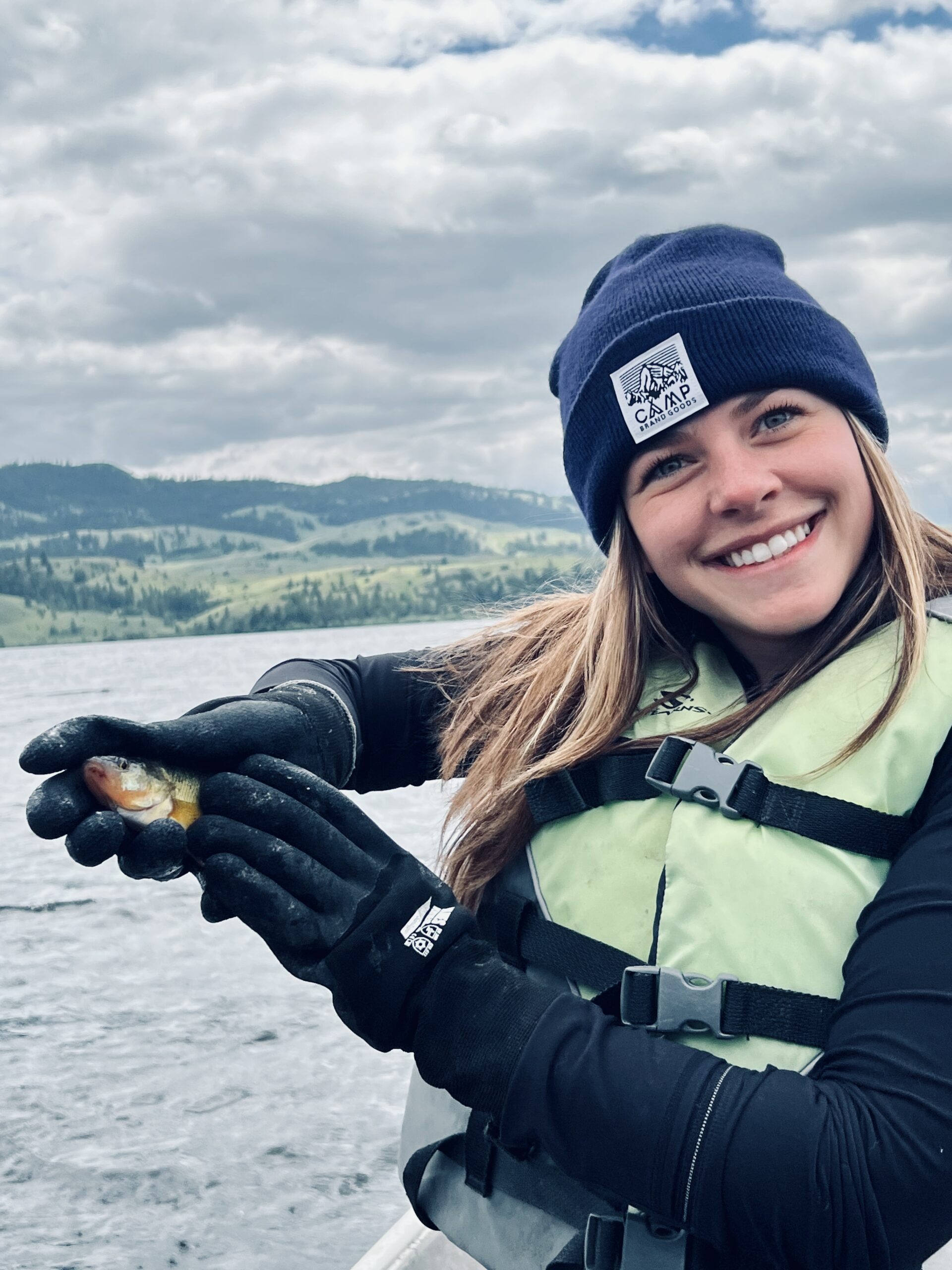
Georgia supporting invasive yellow perch removal efforts with the Upper Nicola Band on Douglas Lake, BC
Georgia Peck, Lakes Program Manager with Living Lakes Canada, is the third generation in her family to work in conservation. She always knew she would follow in the footsteps of her ornithologist grandpa and father, who dedicated his career to shorebird conservation.
“I grew up spending a lot of time on shorelines with my dad,” she laughs. “He was often looking up, and I was far more interested in what was down at our feet: the snakes, frogs and fish. I always had such a love for water.”
After completing her degree in Conservation Biology at Trent University, Georgia moved to BC for a short contract with Lake Windermere Ambassadors (LWA), and following that, was hired by Living Lakes in 2020.
It is fitting that her role with Living Lakes is focused on shoreline conservation. A large part of her job is managing the Foreshore Integrated Management Planning program (FIMP), of which Living Lakes has been the only consistent facilitating organization. She clarifies that FIMP is a public-facing methodology that any qualified environmental professional can use, and she is brimming with excitement about the recently updated FIMP protocols.
From 2019 to 2023, Living Lakes established a 4-year partnership with Fisheries and Oceans Canada, to update the FIMP methodology and field test it on ten high-priority lakes in the Columbia Basin. They focused on lakes in the Kootenays that were surveyed 10 to 15 years prior, including Windermere, Columbia, Kootenay, Slocan, St. Mary’s, Trout, and Arrow Lakes.
Most of the lakes were resurveyed, meaning that the rate of change of natural processes was assessed. “The change in foreshore dynamics, including natural shoreline loss, really does act as a cumulative impact assessment tool,” she elaborates. “This data is then used by local stewardship groups and local governments including First Nations.”
Over these 4 years of surveys, Georgia and her team identified a gap regarding collaboration and inclusion of Indigenous knowledge. Historically, foreshore surveys focused on ecological values, with minimal consideration of cultural, spiritual, or archeological values.
“This gap was an opportunity for us to improve FIMP surveys and ensure they are more inclusive and holistic by including cultural assessments,” she explains. “We also tried to do our part to improve inclusivity in decision making. By ensuring that Indigenous knowledge is interwoven into FIMP, not only in the fieldwork itself, but in the whole project coordination – by co-leading these surveys with First Nations – we’re improving the likelihood that decision-making thereafter will be far more inclusive than it was in the past.”
While this need was identified in the Kootenays, it led to a much larger collaborative FIMP survey project co-facilitated with Sylix Okanagan Nations.
“Through the lessons learned in the Kootenays, we have diversified funding efforts, so that we now have more time at the front end of a project that we dedicate solely to building trusting relationships with partners, many of which are Indigenous. I’ve learned that the quality of the product is not only so much better when you have local context and local knowledge put into it, but the opportunities for implementation are so much larger thereafter.”
Georgia co-wrote the ‘Local Indigenous Knowledge and Values Framework’ with her colleagues Claire Armstrong and Brian Holmes, a councillor with the Upper Nicola Band. “The framework embodies how to collaborate with First Nations during FIMP projects, from project onset to project wrap-up.”
She highly values collaboration and enjoys working with a large diversity of people in her management role with FIMP.
“It’s so important to collaborate and hear everyone’s views. I think trust is an essential pillar in environmental work. It is always worth the time and effort to meet in-person on the land and on the water, to have that boots on the ground connection with the work we’re doing and with the individuals that it’s influencing or impacting.”
Georgia is also involved in delivering training workshops with Living Lakes including a Lake Monitoring workshop for Wildsight’s Youth Climate Corps (YCC) crews and a 3-week water monitoring micro-credential workshop through College of the Rockies.
Despite her persistent enthusiasm, Georgia also speaks to the challenges of remaining hopeful and avoiding burnout in her chosen field. “I’m sure this is the case for all environmental work, but for water specifically it can sometimes feel so discouraging. I remember attending the United Nations water conference in 2023 in New York City. I ended up feeling the most negative I’ve ever felt about the work that we do; it was heartbreaking to hear about the water issues that are being experienced around the world.”
Through connecting with her colleagues here in the Kootenays, she is able to regain hope and inspiration. She highly values the Kootenay Conservation Program (KCP) partnership and the in-person gatherings such as the annual Fall Gathering.
“There’s such a connection and closeness with the people who are part of KCP’s partnership, and reconnecting with them always reminds me why I do the work that I do. There is hope that shines through in the KCP gatherings, and we are reminded why we’re putting in the time and the effort – to maintain this beautiful place that we all live in and call home. It’s always so inspiring to hear about the projects that people are doing here and the work that people are dedicating their lives to. It’s an honour to be a part of KCP; it’s really special to get to share not only the challenges but the wins that we all get to experience doing the work that we do.”