
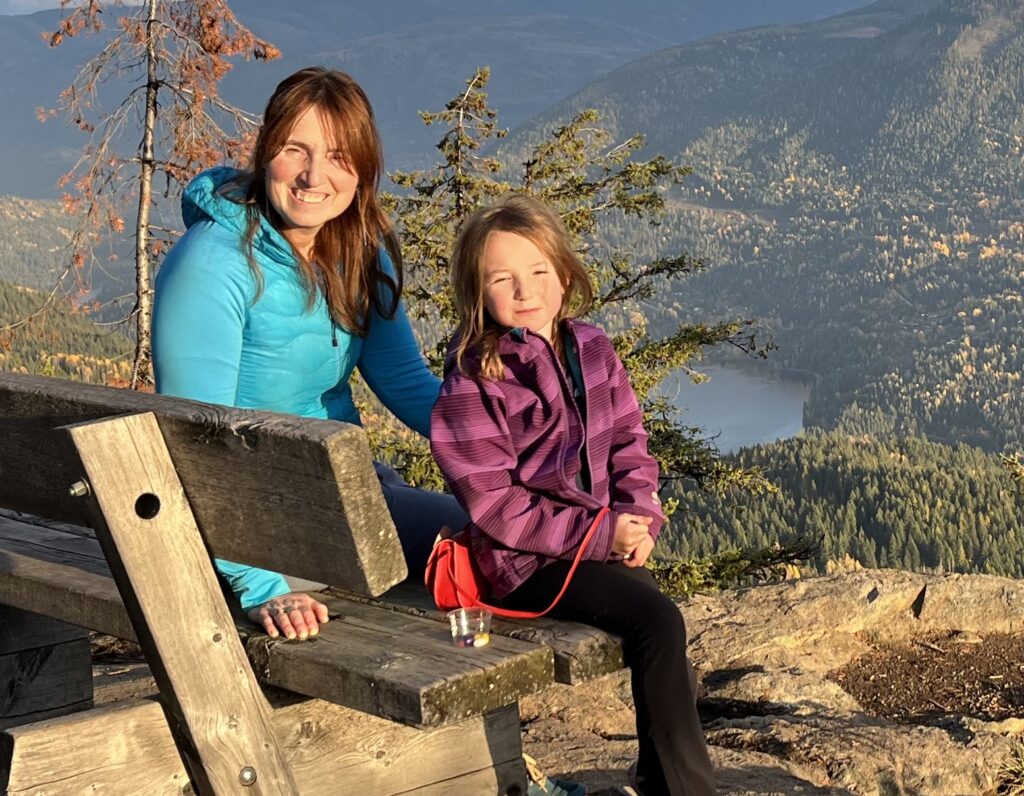
Amy Waterhouse is a Geomatics Specialist working for B.C.’s Ministry of Water, Land and Resource Stewardship (WLRS). Her team is focused on delivering annual and ongoing projects throughout the Fish and Wildlife Compensation Program (FWCP)’s Columbia Region. She is the sole Geographic Information Systems (GIS) provider for the team’s projects and maintains a suite of data collection tools within the team.
FWCP is a partnership between BC Hydro, the Province of B.C., Fisheries and Oceans Canada, First Nations and public interest holders to conserve and enhance fish and wildlife in watersheds impacted by BC Hydro dams, with a vision of thriving fish and wildlife populations in watersheds that are functioning and sustainable.
Amy has spent most of her life in the Columbia Basin — a place she is grateful to call home as she raises her daughter here. Supporting the conservation of fish and wildlife habitat is deeply important to her, and she values the opportunity to apply her skills in a way that makes a meaningful, positive impact.
As a Geomatics Specialist, Amy is passionate about utilizing GIS in a way that facilitates the sharing of information, especially some of the newer storytelling features that are now available. For example, tools like ArcGIS StoryMaps are bridging journalism and GIS to create visual stories that are tactile and far more engaging than the static maps we are used to seeing. Data can be refreshed at any frequency and can utilize additional elements such as video and sound, enabling users to fully immerse themselves in investigating the data.
Amy is currently working on an introductory StoryMap of FWCP-funded projects for fish and wildlife staff and program leads, which will help visualize the footprint impacts of BC Hydro dams. The scale of these impacts on the Canadian portion of the Columbia River Basin is hard for most people to imagine. Approximately 121,600 hectares of valley-bottom habitat have been flooded since dam construction. The Arrow Lakes Reservoir and Kinbasket Reservoir have the largest flooded areas — about 51,270 ha and 42,650 ha, respectively.
This visual StoryMap will replace the original PowerPoint presentation, and Amy envisions that it will eventually be used independently to explore her team’s projects and datasets representing the pre-dam landscape and habitats lost in the Columbia Basin.
When asked about the project, Amy explained that “developing this StoryMap involves revisiting project deliverables from 2009 to 2012, when the Dam Impacts project was conducted, and creating more visual, tangible impressions of what the landscape looked like and how it functioned for fish and wildlife. Viewing the basin in 3D perspective really helps illustrate that flat valley-bottom habitat – including mainly riparian wetlands – have been extensively flooded in the West Kootenay. In the East Kootenay, we are fortunate to have so much of the Columbia Wetlands protected and a connectivity corridor started at the headwaters of Columbia Lake.”
Amy also specializes in improving data collection by applying advances in technology, including the way field staff collect data, using map viewers combined with geospatial forms developed for cell phones or tablets. Using this technology has eliminated most data transcription errors, resulting in higher-quality data and improved efficiencies between field staff working on collaborative projects. Amy enjoys applying new technologies to improve and advance the work she is doing. Looking forward, she is also excited to capture more drone imagery and create orthophotos (an aerial image that has been geometrically corrected) to monitor habitats over time.
She works closely with Kootenay Conservation Program (KCP) as well, stating that “it makes sense for us to collaborate with KCP to meet (FWCP’s) Action Plan objectives. KCP’s area of specialty is collaboration, so there is an important partnership between FWCP and KCP. For example, KCP works with local land trusts to help coordinate conservation land securement in the region. FWCP uses land securement and stewardship tools to mitigate dam impacts affecting fish and wildlife habitat. This includes much of the biodiverse, yet highly impacted valley-bottom habitats that are located on private land.”
Her support for KCP has included summarizing results and creating maps for various initiatives, which she says can be excellent communication tools. In previous years, she has prepared data inputs to support the criteria for conservation property evaluations, and more recently, Amy has “conducted GIS analysis to summarize cottonwood forest land acquisitions and conserved areas by KCP Conservation Neighborhood. I’ve also created maps to show the growth of connectivity corridors over time, since KCP’s inception, and I maintain a spatial layer of conservation properties that KCP has helped coordinate the securement of in the region. I also share my knowledge on provincial datasets and the ones best to use in analysis.”
Amy didn’t always consider herself a technical person, but she always enjoys a challenge. She’s meticulous and persistent and loves the continuous learning aspect of her career. She thrives on the reward of working to conserve fish and wildlife habitat, especially alongside a great team, adding that “it’s wonderful to have a diversity of projects that include partner agencies – we couldn’t do it without the broader team.”


