

The Columbia Lake focal area was added in Year 5 (2023-2024) of Kootenay Connect Priority Places. Consequently, the project results reported for this area are based on the results from Year 6 (2024-25).
Highlights from Year 6 (2024-25)
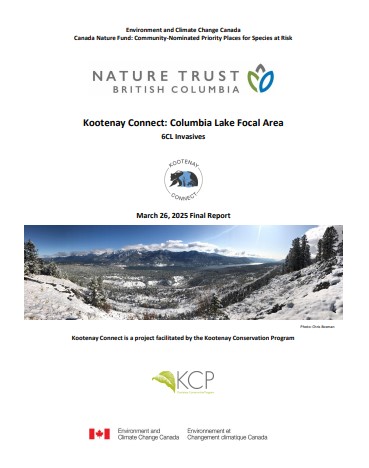
Known as kinq̓uq̓anki in the Ktunaxa language, the east side of Columbia Lake is a beautiful and mostly intact natural landscape that possesses significant cultural and ecological values, particularly to First Nations Peoples who have occupied the land for thousands of years. Over the past several decades, there have been significant land conservation efforts undertaken to minimize threats to the land base. As a result, an impressive assemblage of protected and conserved areas has been established. In 2024, the Provincial Government, the Ktunaxa Nation Council, the Nature Conservancy of Canada and The Nature Trust of British Columbia (the “Partners”) were awarded funding to kinq̓uq̓anki for the first time, through Year 6 of Kootenay Connect Priority Places – Columbia Lake Focal Area. The funding was earmarked to manage invasive plants across this special landscape. By addressing this critical threat, the Partners hope to enhance the ecological health and function of plant communities within kinq̓uq̓anki, while also ensuring that cultural values important to local First Nations (i.e., traditional plants for food and medicine) remain protected. This final report summarizes activities that took place across kinq̓uq̓anki in the first year of the project (2024-25).
In 2024, an invasive plant inventory was conducted in conservation areas on Kinq̓uq̓ankito collect invasive plant data to inform the development of the ISMP and to provide a baseline for monitoring the impacts of invasive species management. The inventory focused on vectors of spread, specifically roads, trails, and disturbed areas. Additionally, the shoreline and wetland habitats were surveyed for invasive species. A total of 174 infestations were recorded during the inventory, accounting for 10 documented invasive species. The most abundant species found in the conservation area was spotted knapweed, with 58 isolated infestations detected. Downy brome (cheatgrass) covers the most area of the conservation area complex, at 8.83 ha, although less sites were detected than spotted knapweed. Chemical treatments took place in July, September, and October, targeting diffuse knapweed, spotted knapweed, St. John’s wort, and yellow hawkweed species, covering 1.07 ha across all conservation areas. Additionally, EKISC and Wildsight Invermere, in partnership with BC Parks, hosted a community weed pull at Columbia Lake Provincial Park on May 25, 2024. EKISC conducted post-treatment monitoring in the East Side Columbia Lake WMA on July 29 (during the invasive plant inventory) and October 8, 2024.


