

Highlights from Year 1 (2019-20) to Year 7 (2025-26) are listed below.
Year 7 Highlights (2025-26)
This video summarizes Kootenay Connect Priority Places projects completed by the Creston Valley Wildlife Management Area (CVWMA), in the Creston Valley, from 2019 to 2026.
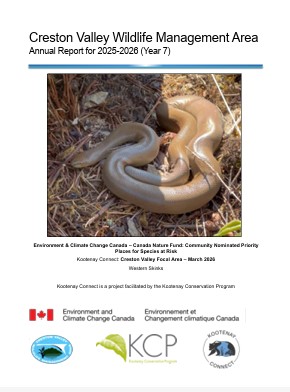
This document reports on the activities completed by the Creston Valley Wildlife Management Area (CVWMA) in 2025-2026, as part of Kootenay Connect Priority Places. The habitat enhancement project, continued, using mechanical treatments on the dry rocky slope habitat around CVWMA’s Administration Office building to enhance habitat for at risk bird and reptile species and for wildfire risk reduction. CVWMA staff continued the reptile monitoring on Creston Mountain, and also monitored the use of the new artificial nesting structure for Barn Swallows (nicknamed the Swallow Resort) at the Duck Lake Nesting Area, which was built in the fall of 2024 as part of Year 6’s activities. In addition, CVWMA staff continued the monitoring of Bobolink in the Frog Bear Conservation Corridor that was initiated as part of Year 5. Results for habitat enhancement and fire risk reduction activities as well as monitoring activities are summarized in this report.
Year 6 Highlights (2024-25)
This video summarizes the work of the Creston Valley Wildlife Management Area in Year 6 of Kootenay Connect (2024-25). One project consisted of building an artificial nesting structure for barn swallows, and the other project focused on habitat enhancement for species at risk including reptiles.
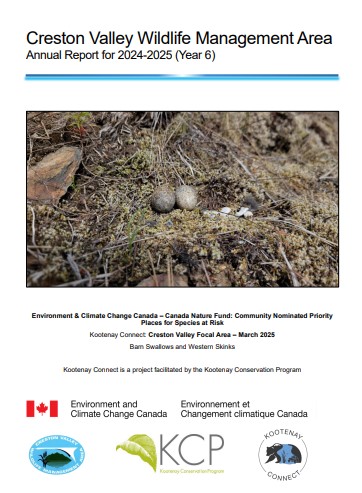
This document reports on the activities completed by the Creston Valley Wildlife Management Area (CVWMA) in 2024-2025, as part of Kootenay Connect Priority Places. The goal of the first project was to construct an artificial nesting structure for the federally threatened Barn Swallows (Hirundo rustica) in the Duck Lake Nesting Area using the design previously used by CVWMA in Corn Creek Marsh near CVWMA’s Administration Office building. The main objective was to build a larger nesting structure than the Corn Creek Marsh “Swallow Hotel” and outfit it with 50-60 wooden nest cups to facilitate nesting. The goal the second project was to conduct manual thinning and brushing to reduce encroaching vegetation and ladder fuel (wildfire risk) on dry slope habitat around CVWMA’s Administration Office building with a specific objective to apply the treatment to reduce encroaching vegetation and improve habitat for wildlife over a 10-ha area. Species at risk that should benefit from the treatment are primarily western skink (Plestiodon skiltonianus), northern rubber boa (Charina bottae), and common nighthawk (Chordeiles minor). This is the first year of a two-year project.
Year 5 Highlights (2023-24)

This document reports on the activities completed by the Creston Valley Wildlife Management Area (CVWMA) in 2023-2024, as part of Kootenay Connect. Specific objectives for the Northern Leopard Frog and Wildlife Movement Connectivity portion of the 2023-2024 Kootenay Connect Project were to monitor wildlife species within the enhanced wildlife corridor. CVWMA focused on species at risk within the connectivity “corridor”, in areas where habitat was enhanced in 2021 and 2022 and did not assess the channels enhanced in 2019 due to staff and time constraints. Staff monitored northern leopard frog movements and nesting Bobolinks through visual surveys, as well as habitat, vegetation, and hydrological changes through photo-point monitoring at fixed locations. The Six Mile Slough Restoration Project (6MSRP) was implemented from early September to mid-October 2023. The five-year restoration project began in early 2019 with primary funding provided through the Columbia Basin Trust’s Ecosystem Enhancement Program and CVWMA. The main objectives for 2023 were to remove six derelict water controls, breach two internal dikes and install two new water controls in Six Mile Slough.
Year 4 Highlights (2022-23)
This video documents the projects initiated and completed in 2022-2023 to enhance habitat for species at risk including Northern Leopard Frogs, Grizzly Bears, Bobolinks and Western Painted Turtles. Projects included construction of an electric fence to exclude cattle grazing from wetland and riparian habitats, digging a new channel near the Duck Lake Nesting Area, and recontouring existing channels in the Frog Bear Conservation Corridor.

This report outlines the Services provided by the Creston Valley Wildlife Management Area (CVWMA) for Fiscal Year 2022/23. The overall goal of this year’s project for Kootenay Connect was to develop and implement designs and prescriptions identified in the CVWMA Connectivity Enhancement of Duck Lake Nesting Area and Frog Bear Corridor (2020-2021) report to: a) improve movement habitat for northern leopard frog migrating between overwintering and breeding habitats; and b) improve cross-valley wildlife movement from the Kootenay River east channel eastward to the Purcell Mountain Range, which would include Nature Conservancy of Canada’s Frog Bear conservation property. A combination of enhancement and restoration activities were selected as “measurable outcomes” based on the “Connectivity Enhancement” report from 2020-2021: channel / waterway edge contouring, wetland creation, native seeding and plantings, invasive plant management, and cattle exclusion fencing – south of the Duck Lake Nesting Area (DLNA), on the West Meadows Farm unit of CVWMA and Frog Bear property. The selected activities intended to improve approximately 30 ha of connectivity habitat for northern leopard frogs, grizzly bears, Bobolinks, and many other species at risk; plus, several bat species should benefit from overall habitat cover and foraging structure complexity in the enhanced areas.
Year 3 Highlights (2021-22)

This report outlines the Services provided by the Creston Valley Wildlife Management Area (CVWMA) for Fiscal Year 2021/22:
- Develop and implement designs and prescriptions identified in the CVWMA Connectivity Enhancement of Duck Lake Nesting Area and Frog-bear Corridor (2020-2021) report to: a) improve movement habitat for northern leopard frog migrating between overwintering and breeding habitats; and b) improve cross-valley wildlife movement from the Kootenay River east channel eastward to the Purcell Mountain Range, which would include Nature Conservancy of Canada’s Frog-bear conservation property.
- Assess archaeological potential and likelihood for the presence of significant archaeological remains.
Year 2 Highlights (2020-21)

This report outlines the Services provided by the Creston Valley Wildlife Management Area (CVWMA), representing the Creston Valley Wildlife Management Authority, in Fiscal Year 2020/21. The CVWMA completed the two Deliverables for Fiscal Year 2020/21:
- Removed derelict water control infrastructure and replaced with a new water control system with two functional sluices gates that allows for improved water flow between Duck Lake and the Duck Lake Nesting Area.
- Design habitat features to improve movement corridor for northern leopard frog between overwintering and breeding habitats. Develop a prescription that would improve wildlife movement from the Kootenay River East Channel eastward to the Purcell Mountain Range, which would include Nature Conservancy of Canada’s Frog-Bear conservation property.
Year 1 Highlights (2019-20)

The Creston Valley Wildlife Management Area (CVWMA) delivered on three Deliverables in Fiscal Year 2019/20:
- Enhance Northern Leopard Frog habitat – Implement o Habitat enhancement for northern leopard frog by dredging, vegetation encroachment removal, and water flow improvement within channel to Duck Lake Nesting Area and entire wetland complex.
- Duck Lake water control – Planning o Design suitable water control to replace exiting one at Duck Lake Nesting Area pumphouse.
- Duck Lake water control – Implement o Purchase water control materials, culvert, and sluice gate before March 31, 2020 to anticipate removal of existing water control infrastructure and replace with new custom-built water control system that regulates water level of Duck Lake Nesting Area to improve habitat for Northern Leopard Frog, Red-necked Phalarope, Short-eared Owl, Western Painted Turtle, and Western Toad.

This map provides an overview of data available for the Creston Valley that includes wildlife habitat features and critical habitat for species at risk to inform protection and management of wildlife movement corridors and habitat connectivity.

This map provides available data for cumulative impacts in the Creston Valley including land ownership, management jurisdictions, and human activity to inform protection and management of wildlife movement corridors and habitat connectivity.


